


On 7 June, Xbox opened its Summer Showcase with new gameplay footage from Gears of War: E-Day, followed by the surprise announcement that E-Day will be exclusive to Xbox and PC, despite original reports suggesting it would be launching on PlayStation 5.
That said, this announcement shouldn’t be too much of a surprise. New Xbox CEO, Asha Sharma, believes exclusive games and software will be a key part of the company’s strategy moving forward, previously telling reporters at a Bloomberg tech event, “To succeed as a platform, we must offer exclusive content and services, and we’re looking at that very closely.”
But make no mistake: this is a very big deal. Gears of War is one of Xbox’s biggest franchises, and players are already wondering what this means for the likes of other major Xbox IPs such as Halo and Fable. For the time being, Xbox CCO Matt Booty has said exclusivity will be decided on a “case-by-case basis.” But that doesn’t mean much to players.
This lack of clarity means the video game industry is currently engaged in hot debate regarding Xbox’s exclusivity strategy. Some players are concerned about the financial and wider marketing implications of locking major franchises to Xbox and PC. Others believe this is a return-to-form for the Xbox brand that will help build brand loyalty and win back lapsed Xbox players.
Like most topics in games, everyone has an opinion. But what do Xbox players really think about the company’s decision to bring back exclusives?
We’ve taken a data-driven approach to the debate by analysing real messages from players in Xbox’s official Discord server.
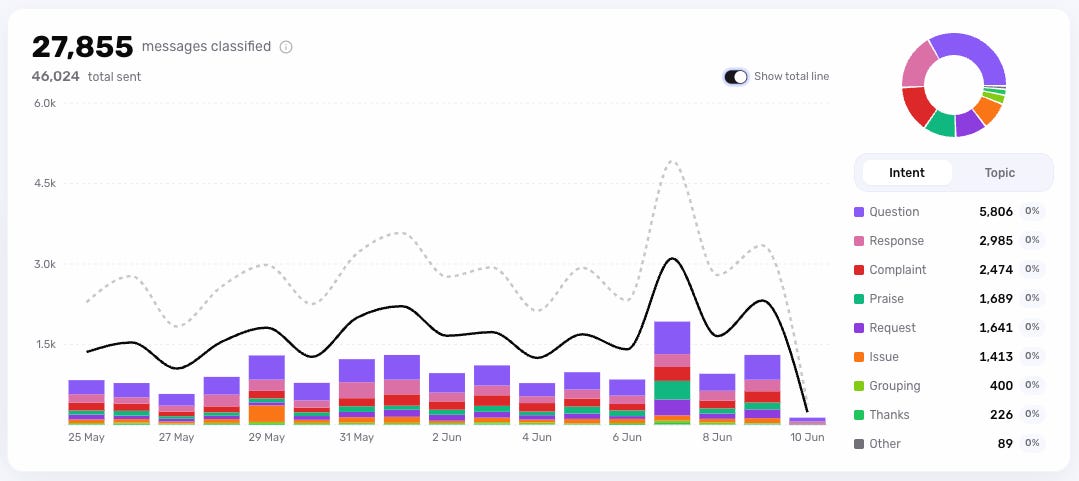
Xbox’s Discord server has nearly 150,000 members, but a lot of these aren’t active. On average, around 2k messages are posted by players every day, indicated by the dotted line in the image above (the black line is messages that have been processed and filtered, and the grid below is messages that can be categorised). As you’d expect, the day of the showcase (7 June) generated the most messages from players.
To make sure our data is accurate and we’re analysing the right conversations, we’ve conducted our research between the 6th and 10th June.
Here’s what we found:
Exclusivity Identified as the No.1 Trending Topic in Xbox’s Discord Server

We knew this would be a hot talking point amongst players as Accord automatically identified exclusivity as a Trending Insight. This tool allows developers and publishers to quickly identify trending conversations in Discord according to their message frequency. In this case, Accord identified players were debating over console exclusivity.
Great, because that’s exactly what we want to look at!
As Accord summarises:
“Players express significant division regarding console exclusives, with a majority viewing them as detrimental to the gaming experience and inconsistent with the Xbox ecosystem’s multi-platform approach. This sentiment is particularly strong concerning first-party titles also available on PC or Game Pass, and third-party exclusive deals.”
But we want to dive deeper into the data. To do that, we looked at where these conversations were taking place: #general-chat


The Xbox Discord server is surprisingly basic when it comes to channel selection. There are three main channels: general-chat, xbox-game-studios, third-party-games, and a forum to discuss specific games, but this is clunky and not being used too much.
As such, a lot of the main chatter takes place in general. And knowing this is where the exclusivity debate is currently happening, we can do a full scrape of the general chat channel across the dates we want to analyse.
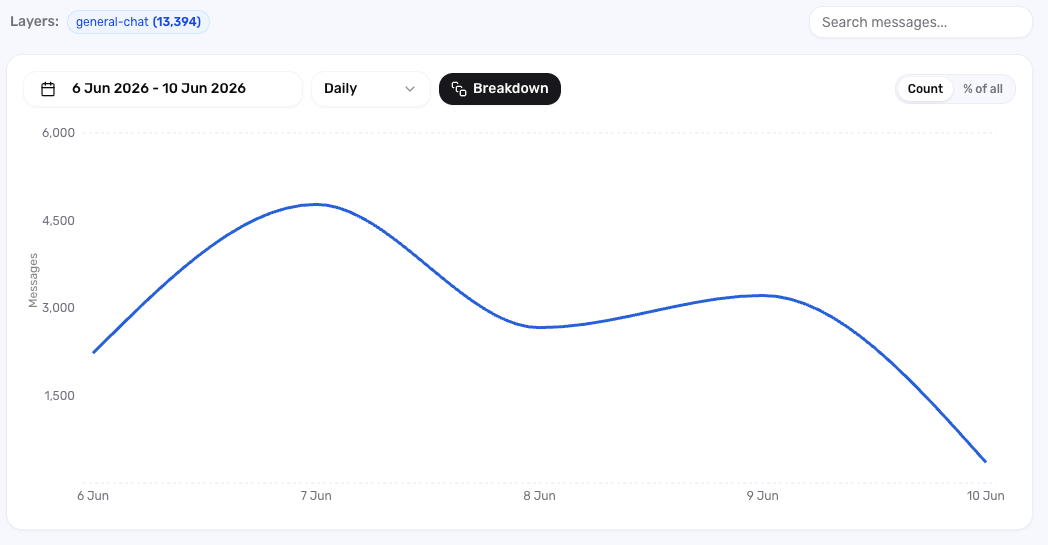
This brings up 13,194 messages to come through. Here’s what we found:
General Sentiment on Xbox Exclusivity
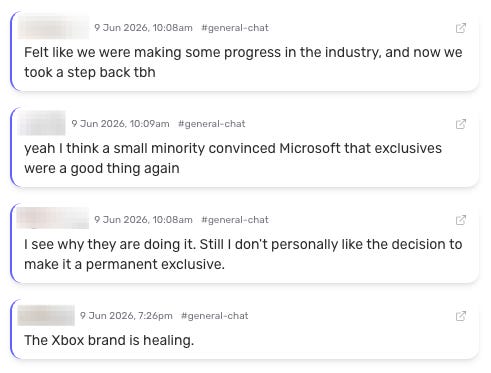
Players are deeply divided on the shift back toward console exclusivity. While some see it as a necessary move to strengthen the Xbox brand, others view it as a regression for the gaming industry. There is a clear tension between those who want to see ‘the three pillars’ (Halo, Gears, and Forza) remain exclusive to define the platform and those who believe the industry was moving toward a more open, multiplatform future.
Over 100 messages spanned a deep debate over whether exclusives are beneficial for the gaming industry or an “outdated business model,” between two different groups.
One group of players argued that exclusives are necessary to incentivise hardware innovation and provide a unique ecosystem. The other group contends that “gatekeeping” titles “hurts” the community and limits the potential audience for developers. Some players specifically noted that while they dislike the practice, they see it as a necessary “quid pro quo” in response to Sony’s strategy.
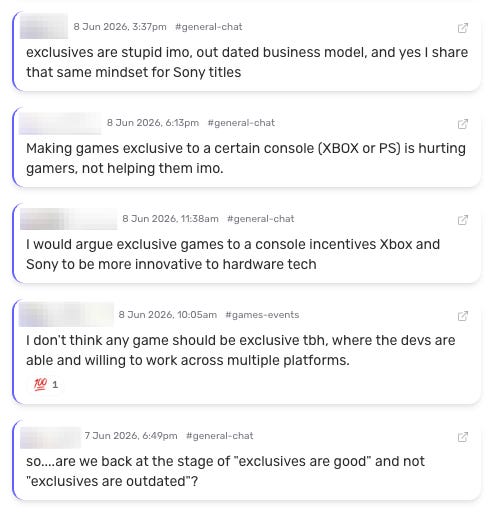
Major IPs such as Halo, Gears, and Forza are also a major point of contention, as there’s a lot of uncertainty around which IPs might receive exclusivity tags moving forward.
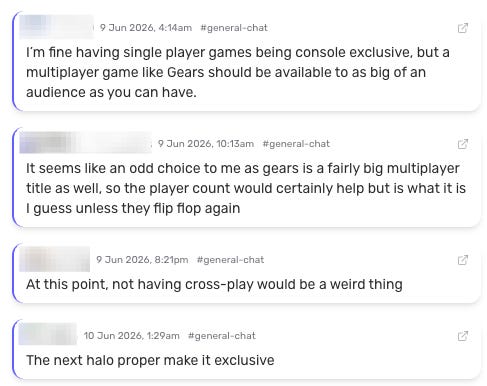
Gears of War: E-Day & Clockwork Revolution: Generally accepted as confirmed exclusives, though some players hope for eventual PlayStation ports. In contrast to Halo and Forza, Gears of War: E-Day is currently viewed by players as a definitive Xbox console exclusive. Discussion across 30 unique messages shows that this exclusivity is a primary driver for some players to choose Xbox hardware. However, a few users argue that multiplayer-heavy titles like Gears would benefit from the larger player base found on multiplatform releases, even if they are comfortable with single-player titles remaining exclusive.
The Elder Scrolls and Fallout: Bethesda is owned by Microsoft, so what does that mean for Bethesda franchises such as Fallout and The Elder Scrolls? For Elder Scrolls, the prevailing sentiment among vocal players is that full exclusivity may be unwise, arguing that the sheer size of the Skyrim fanbase makes a multiplatform release more logical. Others suggest that Starfield's performance as an exclusive serves as a cautionary tale. While Fallout 3 remasters and Fallout 76 were mentioned, there was less direct debate on Fallout 5 exclusivity compared to TES6, though it falls under the general “future games” category where players expect case-by-case decisions.
Halo: While some players are excited that friends on other consoles will finally get to play the iconic series, others remain skeptical or find the shift difficult to process. There is a subset of the community that believes that while remakes can go multiplatform, the “next proper Halo” should remain a core Xbox exclusive to maintain brand identity.
Forza: The general sentiment suggests that making the series multiplatform is a logical move because of the high licensing costs associated with car manufacturers and music.
Game Types Matter with Exclusivity
A significant nuance in the debate is the distinction between game types. Several players expressed that they are “fine” with single-player narrative games being exclusive, but feel that multiplayer-focused titles should be cross-platform to ensure a healthy player population and community reach.
Analysis of chat logs suggests that players are generally more accepting of single-player titles as console exclusives. Titles like Fable (mentioned in ~36 messages) and Clockwork Revolution (mentioned in ~20 messages) are frequently cited as strong candidates for exclusivity because they are narrative-driven and do not rely on a large concurrent player base to remain viable.
Conversely, there is a notable sentiment that multiplayer-heavy franchises, such as Gears of War (mentioned in ~60 messages) and Halo (mentioned in 53~messages), are less suited for exclusivity. Players argue that multiplayer games require the largest possible audience to maintain healthy matchmaking and longevity. Some users explicitly state that while they accept single-player exclusivity, multiplayer titles should be multiplatform to ensure a robust player count.
Confusion Over PC Exclusivity and Console Exclusivity
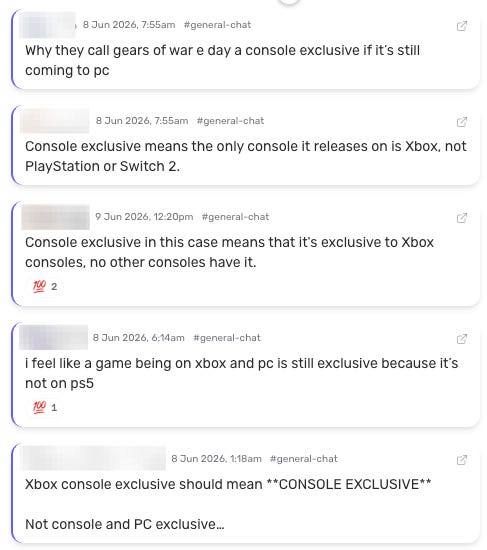
Messages from 50 different players highlighted significant confusion regarding the terminology used during the showcase. Players frequently questioned why games are labeled “Xbox Console Exclusive” when they are also launching on PC via Steam or the Windows Store.
This led to a recurring discussion pattern where veteran community members explained that “console exclusive” specifically means the game will not appear on competing consoles like PlayStation or Switch, rather than being restricted solely to one piece of hardware.
Or as PC Gamer summarises, following some comments from Xbox’s Matt Booty: “this is less about ‘this is on Xbox,’ and more about ‘this isn’t on PlayStation!’”
What Xbox Should Do Next With Exclusivity (According to Players)
Based on the feedback from players in the messages above, here’s what we think Xbox’s strategy for exclusives should look like moving forward:
1. Multiplatform Expansion for Multiplayer and Live Service Games
The majority of players have expressed a strong desire for multiplayer titles to have the largest possible audience to ensure healthy matchmaking and community longevity. Xbox should commit to a multiplatform release for all major multiplayer-focused titles, ensuring no fan gets left behind while leveraging the cross-play capabilities Xbox fans already praise. Popular multiplayer/live-service games will also generate a lot of revenue for Xbox through in-game purchases.
2. Hard Exclusivity for ‘Identity’ Pillars and New IPs
So which games should remain Xbox exclusives? There is significant praise for the ‘Xbox is back’ sentiment following the announcement of exclusive titles like Gears E-Day and Clockwork Revolution. To drive hardware sales and brand loyalty, Xbox should maintain hard exclusivity for new IPs and core narrative reboots that define the ‘Xbox feel.’ This rewards loyal console owners and creates a clear reason to enter the ecosystem for others. Some players suggest that releasing remakes of legacy Xbox games (such as Halo) on other platforms could serve as a “sample” to entice PlayStation players to buy an Xbox for future entries.
3. Timed Exclusivity for Massive RPGs
For titles with massive, multi-generational fanbases like The Elder Scrolls VI, Xbox should utilise timed exclusivity. This allows Xbox to market the game as 'Best on Xbox' and 'First on Xbox' while eventually capturing the broader market revenue, balancing the 'frustration' of permanent exclusivity with the business need for reach.
4. Communication: Eliminating the ‘Mixed Rumors’
Players are confused regarding which games are coming to PlayStation or Nintendo. Apparently, so is Xbox’s Chief Strategy Officer Matthew Ball. Speaking on The Game Business he said: “We have to communicate that internally. We have to communicate that to our partners, but then most of all, at the end of the day, the average player… That's where we're going. We're just not ready to do it yet."
Xbox needs to move away from 'case-by-case' ambiguity and provide a clear roadmap. Players are currently relying on 'mixed rumors' and 'mixed sources,' which leads to hesitation in hardware investment.
If you want to learn more about how you can use Accord to analyse tens of thousands of messages from your game or studio’s Discord server, get in touch.
Don’t forget to subscribe to the PlayerOps newsletter on Substack for more deep dives exploring player sentiment and community management.