


It’s not unusual for successful video game IPs to spin out into new genres. Over the years, we’ve seen real-time strategy versions of first-person-shooters like Halo and Gears of War and, most recently, a deck-building version of Poncle’s roguelike shooter, Vampire Survivors.
Pushing an established game IP into a new genre with different gameplay mechanics is a great way of appealing to new audiences as part of IP expansion plans. And that’s exactly what Danish indie studio, Ghost Ship Games, has done with Deep Rock Galactic, their phenomenally successful co-op shooter that pits dwarf miners against alien hordes.
In 2024, Ghost Ship Games released Deep Rock Galactic: Survivor, a single-player autoshooter modelled on the success of Poncle’s Vampire Survivors. Two years later, and another Deep Rock Galactic game, Rogue Core, has entered Early Access, this time a roguelike spin-off of the franchise.
While Rogue Core has sold an estimated 600k copies after entering Early Access on 20th May, it’s off to a rocky start. One of the challenges of pushing an established IP into a new game genre is that you’ll have players with pre-conceived ideas of what the game should look like, how it should play, and how “true” it is to the main franchise it’s based on.
Player counts for Rogue Core have fallen significantly since the Early Access release, and while Ghost Ship Games is making active updates to the game, there’s still some way to go if the studio wants to win back the players it lost at launch.
With over 650k players in the official Deep Rock Galactic Discord server, we wanted to take a look at what players are saying about the game, what improvements they’d like to see, and what Ghost Ship Games should do next to bring more players into Rogue Core.
To do that, we analysed more than 120k player messages posted in Discord channels related to Rogue Core. Note: we’ve only analysed Discord channels that were created for Rogue Core discussions such as rogue-core-chat, so these figures aren’t indicative of message volumes across the entire Deep Rock Galactic server.
Here’s what we found, along with some lessons for other game studios interested in expanding their IPs into new genres.
Early Access Launch
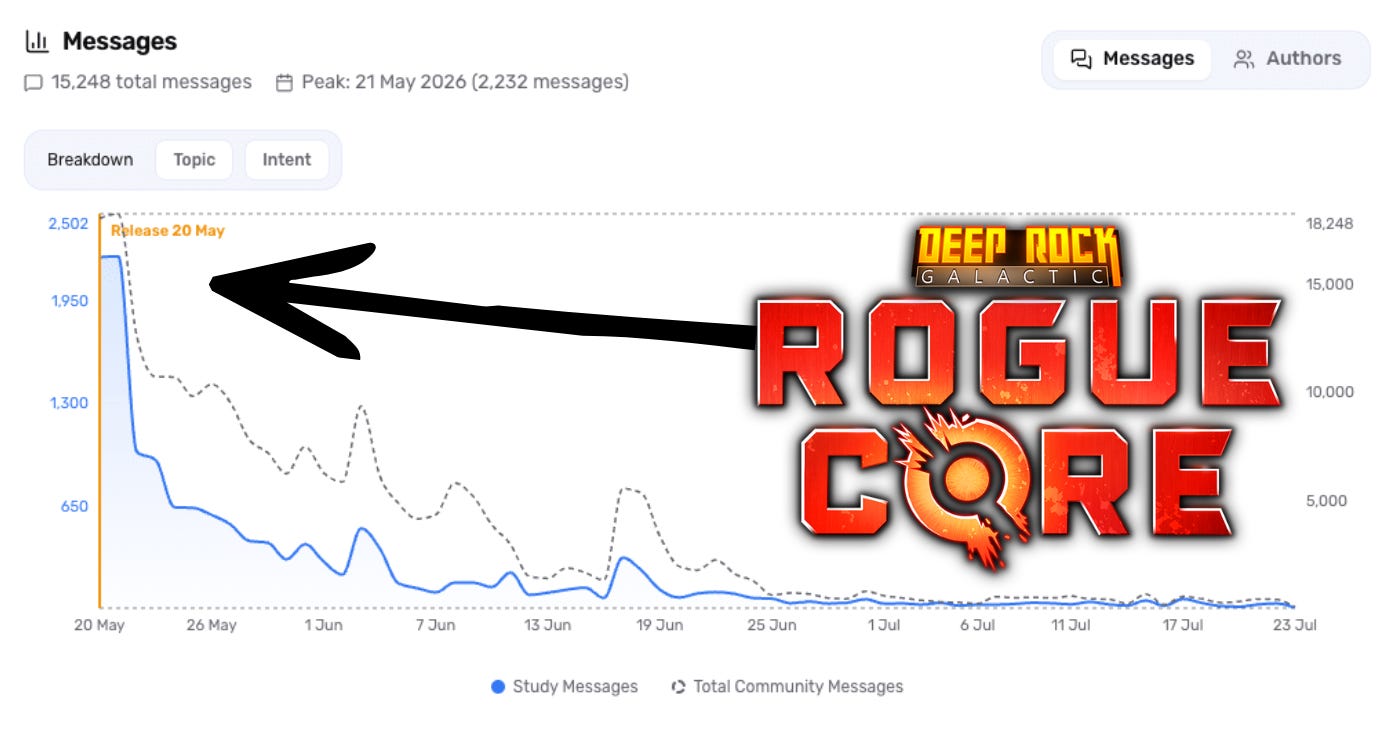
Rogue Core entered Early Access on 20th May 2026, peaking at 42,716 CCU, according to Steamdb. With the exception of the game’s first patch release on 17th June, CCUs have been on a gradual decline, currently hovering around 1000 at the time of writing.
While it’s not unusual for playercounts to experience a sharp drop-off after launch, this gradual decline lines up with activity in the game’s Discord server and suggests the game isn’t living up to the expectations of players.
According to our analysis of 15,000 messages posted in the first week of the game’s Early Access period, Rogue Core has generated a highly engaged yet polarised response from the Deep Rock Galactic community, indicative of the “mostly positive” reviews on Steam.
The community is divided between players who praise the new direction of the IP and defend its Early Access status, and those who are critical of its differences from the original Deep Rock Galactic.
This level of polarisation is one of the biggest takeaways from the Early Access period and shapes much of the discourse around the launch. Over 200 unique players contributed to this discourse in Discord, with supporters either expressing strong faith in the developers, with quotes like “the game has the same soul as DRG,” while others call it “an insult to the first game” and ask, "why isn’t this more like Deep Rock”
Arguably, Rogue Core is a victim of Ghost Ship Games’ earlier success with Deep Rock Galactic, something the studio even alluded to in the run-up to the game’s launch when they said:
“Heading into our Early Access launch, it’s inevitable that folks will compare Rogue Core against Deep Rock Galactic. We do it too. But it's worth remembering that Deep Rock Galactic has had about ten years more development than Rogue Core”

Ghost Ship Games has built a thriving community around Deep Rock Galactic, which is full of players who want to see the studio succeed. This is something you see a lot with indie devs and publishers (see our analysis of Paralives in the last edition of PlayerOps), so it’s no surprise to see so many longtime players of Deep Rock Galactic advocating that Ghost Ship will address many of the most common complaints about the game.
Early Access releases usually experience technical issues at launch, and this was one of the biggest complaints with Rogue Core.
According to player messages in Discord, these technical issues included:
Game-breaking and widespread multiplayer connectivity issues resulting in black screens, connection errors and empty server browsers, especially on Steam Deck. These were mentioned by over 200 unique players.
Technical issues that prevent the game from launching or loading correctly are mentioned by over 80 unique players. Reports include error popups like “Launch ga” or Create Prosses returned 24”
In-game bugs relating to physics, abilities, and player states that can prematurely end game runs. They were mentioned by over 50 unique players, with specific issues including critical boss objects getting stuck, players becoming unrevivable, rejoining games in weaponless states and abilities not working.
Most of the game’s major technical issues were quickly patched, but another topic of hot debate is comparisons with the original Deep Rock Galactic.
Specific comparisons with Deep Rock Galactic (base game)

While Rogue Core and Deep Rock Galactic are two very different games, we thought it would be interesting to look at comparisons between the two, as this is such a major point of contention amongst players. To do this, we analysed over 4000 messages from players making comparisons between the two games.
Difficulty and pacing - Over 500 messages expressed frustration that Rogue Core is significantly harder and more stressful than DRG. The threat timer and relentless swarms leave little “room to breathe” compared to the original game, although more hardcore players complain the game has become “too easy” after updates [see further down
Weapon balance and feel - Nearly 200 messages focus on how weapons transitioned from Deep Rock Galactic to Rogue Core. Some iconic weapons, like the M1000 (M1K) and the Warthog, are criticised for feeling much weaker, less accurate, or having severe ammo issues in Rogue Core compared to their DRG counterparts.
Rogue Core’s forced cooperation versus the freedom of Deep Rock Galactic - Nearly 100 messages specifically compared the cooperative mechanics, noting that Rogue Core’s shared upgrade system forces players to stick together and coordinate tightly, which can feel overly restrictive and punishing in public lobbies compared to the more flexible cooperation in DRG.
Fear the Cave Leech - Another specific frustration is the sheer density of powerful Cave Leeches in Rogue Core, which deal very high damage. Players note that while Cave Leeches are relatively rare in Deep Rock Galactic, they appear in massive numbers per stage in Rogue Core, leading to constant “chain grabbing” and team wipes.
What players love most about Rogue Core

Despite a rocky launch, players expressed strong positive sentiment regarding several key mechanics, classes, and upgrades that enhance their gameplay experience. We analysed nearly 6000 player messages categorised as ‘praise’ to highlight some of Rogue Core’s most celebrated features and elements.
Class design and unique abilities (over 500 messages)
The most prominent area of praise in the sample focuses on the five playable classes -Spotter, Slicer, Retcon, Falconer, and Guardian - and their highly distinct abilities.
Spotter: Celebrated as an essential support class, players love the utility of the radar scan and the high-impact guaranteed critical darts that melt bosses.
Slicer: Praised for unmatched mobility, satisfying melee-focused builds, and the ability to generate massive overkill damage numbers.
Retcon: Highly favored for solo play and clutch saves, with players loving the “rewind time” mechanic and the aggressive “barbarian” playstyle.
Falconer: Praised for passive crowd control via the shock drone, chain lightning synergies, and the ability to revive teammates from a safe distance.
Guardian: Appreciated as a dedicated backline protector, utilising stuns, forcefields, and armor-stacking buffs to keep the team alive.
Challenging gameplay loop and timer tension (over 300 messages)
Players heavily praise the high-stakes, fast-paced nature of Rogue Core, noting that it offers a refreshing contrast to the more relaxed pace of Deep Rock Galactic. The inclusion of a difficulty timer is highly celebrated for forcing teams to actively coordinate, prioritise objectives, and manage risks under pressure. Rather than finding the difficulty frustrating, players report that clutching victories with random teammates or friends provides an immense sense of satisfaction.
Progression adjustments and QOL updates post-launch (over 250 messages)
Ghost Ship Games received substantial praise for their rapid response to player feedback during early access. A recent patch that reduced merit costs for early ascensions, enhancement tree gates, and deployment slots was met with widespread gratitude, as it significantly smoothed out the progression curve.
Players also highlighted several QoL improvements, such as faster default mining speeds, the inclusion of a late-join feature for the first stage of runs, and the implementation of highly versatile traversal tools like the Anti-Grav Emitter and improved ziplines. The addition of a highly-requested auto-sprint feature (Update 1) was also praised by 30 unique players.
Immersive audio, voice acting, and the ascension ceremony (over 100 messages)
Rogue Core’s presentation and atmosphere are major highlights for the community. The game’s prestige/promotion event, The Ascension Ceremony, is praised as a beautiful, cinematic team event that fosters comradery. Players also highly commend the voice acting, particularly the new female dwarf voice actresses, who deliver lines with a perfect blend of humor and grit. The robotic companions, Omega and Cooper, have also become fan favourites due to their quirky humour and double act.
Areas of Rogue Core that need improving

Similar to the above, we analysed over 14,000 player messages posted since the game’s Early Access launch that have been classified by Accord as a ‘complaint’ or ‘frustration’ relating to 14 sub-categories of the game, such as gameplay, balance, economy, and resources. We’ve excluded bugs and technical hurdles from this filter to focus on core mechanics and features.
Polarising difficulty shifts and power creep (over 800 messages)
As a roguelite game, Rogue Core does have a relatively high barrier to entry, but a frequent source of frustration among players centers on the game’s difficulty balance, which has become highly polarised.
A large portion of the community is frustrated that recent updates have made the game far too easy, even on Depth 4 and Reckless settings. They point to massive player power creep, an overabundance of ammo and red sugar, and overpowered upgrades like “Boom! You’re Dead” that allow teams to spawn-camp and vaporise waves instantly.
Conversely, a smaller but vocal group of casual and cooperative players find the game excessively punishing and difficult, especially when playing in duos. This highlights one of the biggest pain points of success with a game franchise as popular as Deep Rock Galactic: you can’t please everyone!
Friction over the upgrade negotiation [shared rewards pool] system (over 500 messages)
Players are heavily frustrated by the mechanics of the upgrade draft system, which uses a shared rewards pool. The removal of the “skip for health” option and the standardisation of upgrade rarities in updates have drawn criticism for reducing strategic choice and making the first picker feel disadvantaged.
The cooperative aspect of the draft frequently breaks down in public lobbies, leading to resentment when teammates greedily snatch upgrades meant for other classes or prematurely trigger upgrades mid-swarm without consulting the team.
Tedious boss mechanics and invisibility frames (over 200 messages)
Boss encounters are another major pain point. Players express frustration with mechanics that disrupt the flow of combat, specifically the introduction of invincibility frames and phase gates that make bosses temporarily immune to damage. Attacks like Ramok’s tornado (mentioned by 20 unique players), Molaktula’s constant spinning and ground spikes, and Gotoorak’s repetitive knockback attacks are criticised for being tedious, hard to avoid, and overly punishing, especially for solo players who have no breathing room to resupply or revive teammates.
Underwhelming class kit for the Guardian (over 50 messages)
The Guardian class is a frequent target of complaints, widely regarded as the weakest and most sluggish class in the game. Players find his abilities, such as the armor beacon and fear aura, to be highly underwhelming due to excessively long cooldowns and a lack of meaningful impact compared to other classes that can easily clear waves. His Protection bio-booster deck is also criticised as being extremely weak and unrewarding, leaving players feeling like they are playing at a severe disadvantage.
A rock in a hard place - what Ghost Ship Games should do next

As Ghost Ship Games continues to update Rogue Core, we wanted to learn more about the specific changes that players want to see. We analysed nearly 1000 messages from the last two weeks that could be identified as feedback or improvements (note: this doesn’t mean they’ve been posted in feedback-specific channels) to get a better idea of what players think Ghost Ship Games should do next.
Of course, one of the biggest challenges facing Ghost Ship Games is the casual vs hardcore split amongst players. While the debate over the game’s difficulty will surely never be settled, the suggestions below could appease some of the game’s more vocal critics.
Better class identity and mobility options
Many players expressed a desire for stronger class identity, noting that the current classes feel too similar. A major point of discussion was the reliance on the “big three” team traversal tools (zipline, drills, and anti-grav emitter). Multiple players (over 40 unique) suggested introducing unique, individual mobility skills for each class to reduce this reliance and enhance skill expression.
Upgrade negotiation and reroll systems
This is something that Ghost Ship Games has already said they’re actively working on in previous update notes, but players frequently discuss the upgrade negotiation system, with many suggesting the addition of a reroll mechanic to mitigate bad RNG. Others proposed features like favouriting multiple options, voting systems for multiplayer lobbies, or allowing players to skip to the back of the queue to let upgrades cycle.
More variety for missions and cave generation
Over 40 unique players demanded more variety in mission objectives and cave layouts to prevent the gameplay loop from feeling repetitive. Players suggested alternatives to the standard elevator defense sequence, such as repairing a damaged elevator, searching for parts, or introducing unique objectives that persist between floors.
Turret balancing for the Retcon class
Retcon’s turrets were a frequent target of balancing discussions. Players noted that the ability to spam numerous turrets can trivialise boss fights and turn the game into an “afk sim” for teammates. Suggestions to balance this included implementing hard caps, adding ammo limits, or introducing setup times.
Hotbar and weapon slot customisation
Several players requested the ability to rearrange weapons and equipment slots on their hotbar. Currently, players feel restricted when they cannot move items to their preferred slots, leading to minor frustration during gameplay.
Takeaways for other game studios on IP expansion
Analysing the player response to Rogue Core and how the game has managed future patches and updates reveals some wider lessons for game studios who might be interested in pushing their IP into new game genres
Comparisons with the base game are unavoidable
You can’t please everyone. As we’ve seen from the polarised response to Rogue Core, there are players who praise the game for staying true to the identity of Deep Rock Galactic, while others say it strays too far. Be mindful that the inclusion of any specific gameplay elements (characters, weapons, locations) will undoubtedly draw comparisons with how they look or feel in the base game.
Be mindful of difficulty and genre compatibility
While the aesthetic and premise of Deep Rock Galactic lend themselves well to a roguelite game, there’s a noticeable difference in difficulty. Roguelite games are notoriously difficult and take a while to pick up due to your character’s weak starting state, whereas Deep Rock Galactic was accessible as it had a decent mix of difficulty levels.
Given how successful the original game is, it’s not surprising that a large number of players find Rogue Core too difficult - especially if they’ve never played a roguelite game before.
Keep players informed and updated
This might seem like an obvious one, but something we see consistently across our analysis of indie games is that studios that keep a strong line of communication with players and act transparently will always receive good favour when things go wrong. Ghost Ship Games has done an excellent job of sharing feedback and responding to players as they update Rogue Core, and maintaining a healthy Discord server and setting up dedicated channels for feedback is an important part of that.
Need help turning your player messages from Discord into actionable insight that can help you ship better games? Get in touch for a free demo.
Don’t forget to subscribe to the PlayerOps newsletter on Substack for weekly posts and data-driven articles exploring player feedback and why it matters for studios and community leaders.