


With 132 million daily active users, Roblox has become one of the most important platforms for brands targeting Gen Z and Gen Alpha audiences, whether it’s through advertising campaigns, UGC, custom-built games, or limited-time integrations in the most popular games on the platform.
Custom-built games used to be one of the most popular choices amongst brands to reach these audiences. But they’re expensive to make, and there’s no guarantee that the investment into building them will pay off – especially with so many major branded games already dominating this space.
That’s why a growing number of brands are focusing their attention on branded integrations instead, where their IP is integrated into existing (and usually very popular) games on the platform in limited-time events. The mechanics of these events can vary significantly from game to game, but they might introduce new characters, items, UGC, game modes, or mini-games based on the brand’s IP.
These integrations have become so popular amongst brands that Roblox has launched Roblox Brand Link, a dedicated matchmaking tool for game developers and IP holders. But while integrations are cheaper and less time-intensive than building a game from scratch, they face two major challenges:
How do you integrate branded content into a popular game without disrupting the player experience?
How do players feel about branded integrations?
To find out, we thought it would be interesting to team up with Stephen Dypiangco at Max Power Gaming and analyse Discord messages relating to six major brand integrations in popular Roblox games:
Methodology
Collectively, the official Discord servers for these six games have over two million members.
We analysed more than 100,000 player messages from the official Discord servers for the games mentioned above, with our analysis taking place during the duration of the events, and a week before they started to catch announcement messages.
Using Accord’s Research tool, we created new studies for each of the integrations above. By feeding Accord a detailed description of the event along with date ranges, we eliminate any player messages that aren’t related to these integrations. To gather extra data, we also ran searches for brand mentions and specific keywords across entire Discord servers.
Why Discord is an important tool for Roblox developers
73% of the top-100 Roblox games have Discord servers, where players will regularly discuss game updates and share their feedback on IP integrations. Member counts are typically between five and six figures, although some Roblox games such as Steal a Brainrot (8 million), Grow a Garden (5 million) and Blox Fruits (3 million) have more members than even the biggest PC/console games.
While some studios will set up dedicated channels for player feedback, our research consistently finds that some of the most valuable player conversations take place in general-chat channels, which are much harder to monitor due to their high message volumes.
We wanted to find out if these messages contain valuable insight that Roblox studios can utilise to build better IP integrations in the future (spoiler: they do).
Here’s what we found, along with our top tips on how Roblox developers can use player feedback in Discord to build better experiences for their players.
1. Players constantly tell developers how to improve collaborations
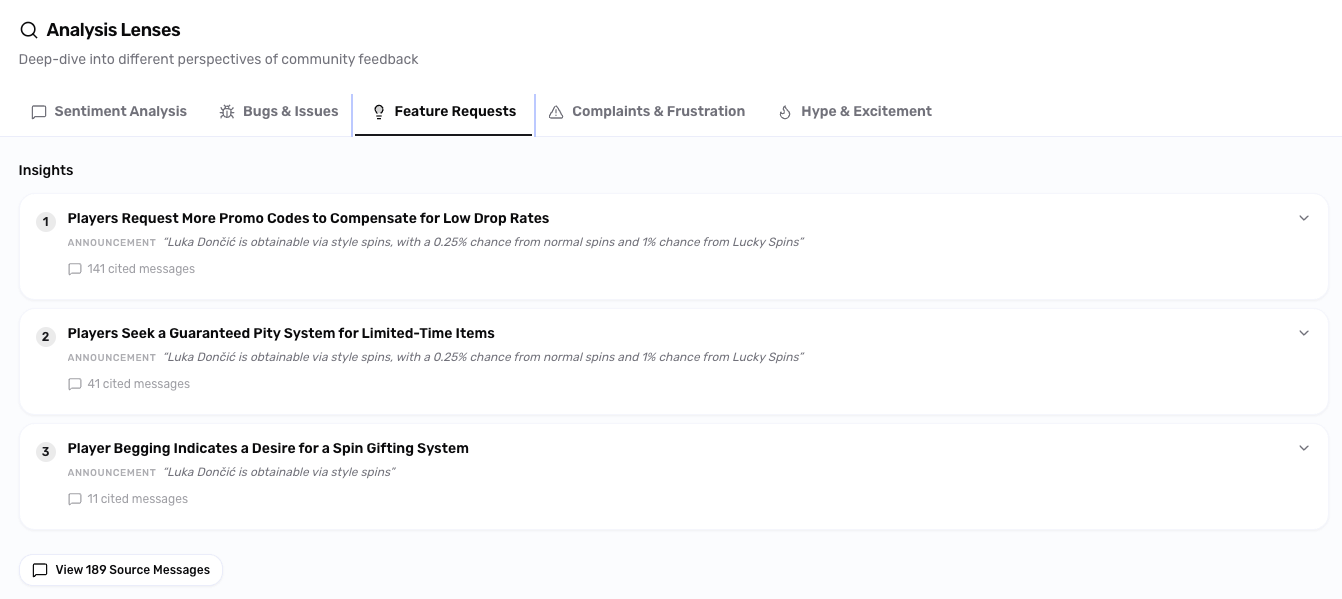
Players can be quick to criticize and slow to praise, but our research found that they consistently provide useful feedback in the form of feature ideas, reward structures, balancing suggestions, and even event concepts to improve on areas they weren’t keen on. We found over 1000 messages across the six integrations that were requests or suggestions.
Brookhaven’s players suggested more “lore-connected events” to contextualise brand integrations. Others wanted to see the LEGO firehouse, which was added as part of the event, become a permanent location.
Basketball Zero contains gacha (lucky spin) mechanics to unlock characters, and Luka Dončić was incredibly rare to obtain. Players requested a guaranteed pity system for future collaborations so they would automatically receive characters after a certain number of pulls.
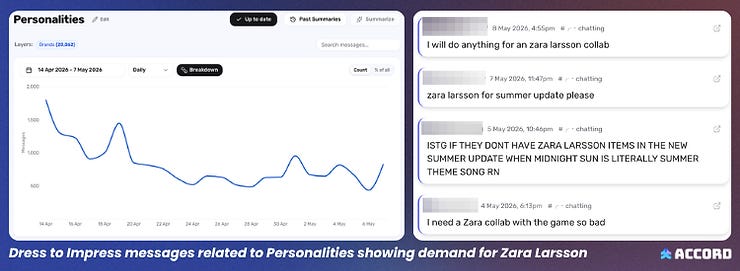
Dress to Impress players requested additional and higher-quality cosmetic sets for future music collaborations. They also suggested more licensed tracks in gameplay areas and standalone events to avoid clashes with wider season updates running at the same time.
Driving Empire players asked for better vehicle balancing and the return of a popular Red Bull livery, which was removed from the game with this update.
Welcome to Bloxburg players were frustrated by the inability to recolour the IKEA furniture pieces and requested more customisation options for similar collaborations in the future.
Evade players requested clearer and more reliable quest tracking in future updates so they could accurately guage process for specific unlockables.
KPIs tell you:
How many people played
How long they stayed
What they unlocked
Discord tells you:
Whether the collaboration felt authentic
Whether rewards felt fair
Whether players understood the event
Whether the IP was integrated smoothly
Whether branded events are a good match for your game and players
2. Discord feedback exposes a gap between “engagement” and “satisfaction”
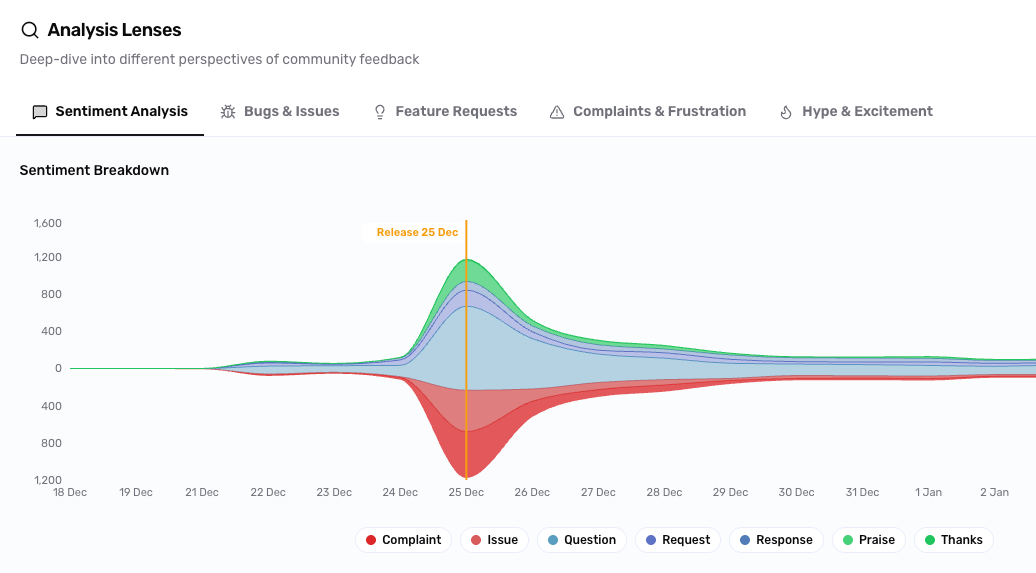
One of the biggest challenges surrounding branded integrations is how to measure success. Metrics such as daily visits, engagement time/session length, and brand impressions can be useful KPIs, but these don’t always tell us whether players have had a positive or negative experience with an in-game branded experience.
As Stephen highlights in his write-up from a brand perspective, “no two integrations perform the same way, even in games with identical traffic. A brand like Netflix could show up in two different games, each getting five million visits, and see completely different results depending on how the integration was executed.”
When we analysed these six integrations, we found the collaborations that generated a lot of discussions also generated a lot of criticism, highlighting that big numbers don’t automatically equate to success.
That’s not to say these collaborations weren’t successful. As an example, the KATSEYE collaboration in Dress to Impress boosted player visits by 170% at launch, but several players called it “underwhelming” or “mid” in comparison to other music collaborations in the game.
Similarly, the Luka Dončić integration in Basketball Zero generated tens of thousands of messages from players, but player sentiment was significantly worsened by bugs and how difficult Luka was to obtain as a character.
Without proper Discord and community analysis, developers and IP holders risk concluding that high participation and retention mean the integration was a success.
3. Players care more about how the brand is integrated rather than the brand Itself
Evade’s collaboration with Stranger Things: Tales from 85 was the studio’s second collaboration with a film/TV IP. This integration ran alongside the launch of a new TV season and drove a lot of excitement from players, but discussions around the IP quickly became dominated by bugged rewards and unclear quest requirements.
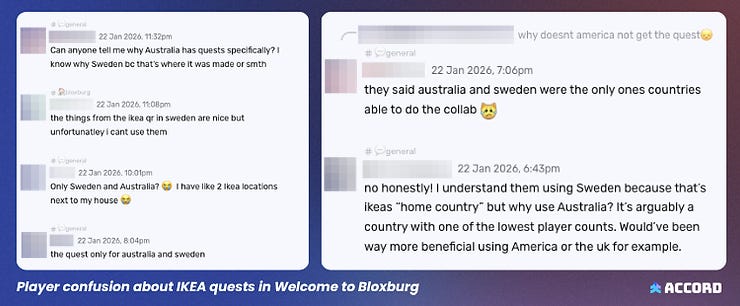
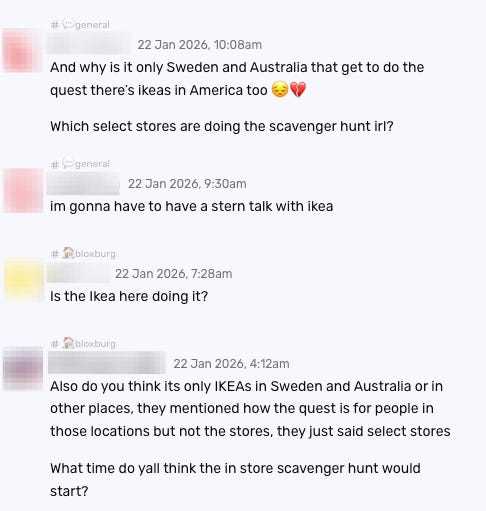
Similarly, Welcome to Bloxburg’s collaboration with IKEA was praised for being the right brand fit. It’s a lifestyle/simulation game, so a collaboration with a furniture brand makes perfect sense. The brand wasn’t the problem. As some of the rewards were only available to players in Sweden and Australia, player criticism centred on region locking, inventory issues, and limited furniture customisation.
A great brand integration can still produce negative sentiment if the mechanics feel unfair, confusing, or buggy. For developers, this highlights the importance of stress-testing experiences and giving yourself enough development time in the run-up to launching branded integrations.
4. Roblox players don’t hate branded collaborations if they feel authentic “the right fit”
Building on the point above, this is one of the most consistent findings from our analysis.
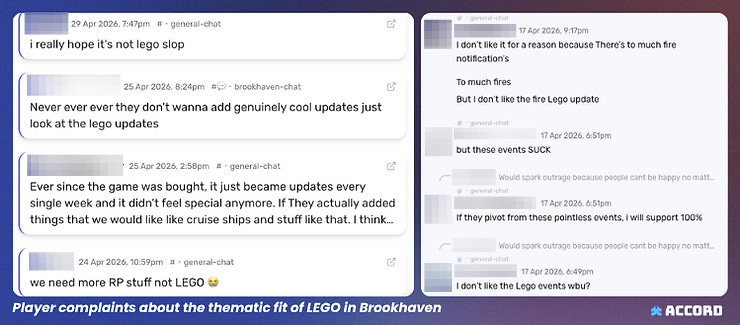
IP integrations that felt like a “natural fit” were praised by players, while those that felt like a mismatch aesthetically or thematically generated more negative messages from players.
Brookhaven’s collaboration with LEGO introduced new gameplay mechanics where players could roleplay as firefighters and put out various fires across the city. While some players praised the inclusion of LEGO and even set up dedicated LEGO roleplay groups in Discord, others said the LEGO collaboration feels out of place and would prefer events that are more integrated with the game’s lore.
For KATSEYE’s collaboration in Dress to Impress, approximately 145 players shared their opinions on the overall quality of the collaboration. While some expressed excitement, a large volume of feedback was critical, describing the update as “underwhelming” or “mid” compared to previous events like Lady Gaga or Charli xcx. A recurring complaint was that the KATSEYE collab overshadowed the “Trip to Tokyo” update, and it was confusing having a K-pop event run alongside a larger Japanese-themed seasonal update.
Despite some frustrations (such as the removal of a popular livery) Driving Empire’s NASCAR collaboration garnered a highly positive response from players due to its “natural fit” - a car brand in a racing game. It launched alongside the IRL Daytona 500 Race, significantly boosting player excitement while prompting large-scale community activities such as a 100-player NASCAR race
Discord data shows that players judge collaborations through the lens of game identity.
A brand fit that looks sensible in a pitch deck may feel completely wrong to players living inside the game world every day.
5. Roblox players often struggle to understand event mechanics - studios should improve communications
Player criticism isn’t always directed at the collaboration itself. Our analysis consistently found evidence of players being confused about event mechanics, what rewards they could get, whether something was bugged, or what they were supposed to do.
Often, this is the result of poor in-game prompting or a lack of specific information on game pages. And as most of these IP integrations are only written up by specialist Roblox or brand newsletters, there’s a general lack of visibility when it comes to event information and what players should do – especially while these events are taking place.
The strongest example is probably Evade x Stranger Things. Players were told to watch an episode of the TV series but weren’t told how long the episode lasts or how long they should watch for. This caused confusion about what counted as completing the event quest. Community members ended up having to explain rules that the game itself never clearly communicated.
Similarly, the low drop rate for Luka Dončić in Basketball Zero made many players wrongly assume that unlocking the character was bugged and couldn’t be done, while Welcome to Bloxburg’s IKEA collaboration caused confusion and disappointment due to region-locked content for a global game.
Tips for building better IP integrations in Roblox
If you’re a Roblox developer considering integrating an IP for a limited-time event, here are some best practice lessons to avoid upsetting players and help you find the right brand match.
Make the collaboration feel native to the game
Don’t start with “which brand can we partner with?” Instead, ask yourself what type of brand could naturally exist inside your game and feel like an extension of your game world.
Over-explain event mechanics and rewards
Assume players will skip instructions. Explain key mechanics and unlocks in-game, on event pages, in Discord, on Reddit and in FAQ posts. If hundreds of players are asking the same question in Discord, you haven’t communicated clearly enough.
Design rewards that feel unique, not interchangeable
One recurring complaint was that rewards felt too similar to content players already owned. While it makes commercial sense to reuse and repurpose existing assets and mechanics, make players feel rewarded for taking part in an experience.
Create hype before launch, not just during the event
Some of the most successful integrations generated excitement weeks before release. Build hype through speculation, phase announcements and launch teasers to build excitement.
Use Discord as a live feedback system, not a post-mortem tool
Whether it’s criticism or praise, Discord will be the primary platform for most players to share feedback with other players, especially if it will help them quickly diagnose a potential issue.
Don’t wait until the event ends to analyse feedback. Monitor Discord daily to identify and action feedback before it becomes a problem.
If you need a tool to help you do that, Accord can help! Get in touch with us at contact@accord.gg
Don’t forget to subscribe to the PlayerOps newsletter on Substack for weekly posts and data-driven articles exploring player feedback and why it matters for studios and community leaders.